OrbitalWatch
Real-time space situational awareness dashboard that tracks 40,000+ orbiting objects, calculates collision risks, and simulates launch clearances on a 3D WebGL globe.
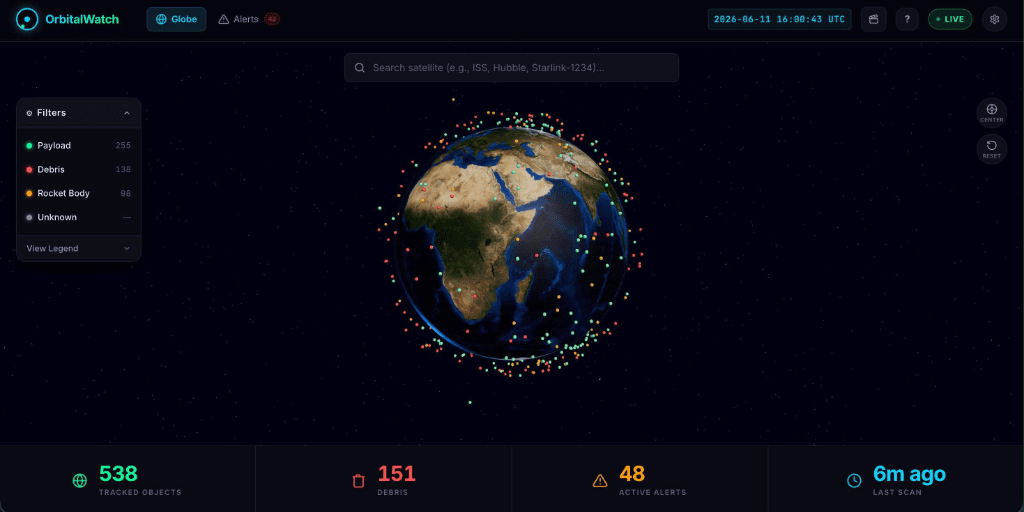
OrbitalWatch is a real-time Space Situational Awareness (SSA) dashboard that tracks 40,000+ orbiting objects, calculates collision risks, and evaluates launch trajectory clearances. Ingesting live TLE data from Celestrak and propagating positions with SGP4, it is designed as a free, open-source alternative to commercial space situational software that costs $10K–$100K+/year.
Commercial SSA tools are priced out of reach for university labs, CubeSat operators, and independent debris researchers. Building a scalable tracking solution requires resolving heavy telemetry streaming and complex conjunction collision checks in real time without lagging the browser.
The platform uses three decoupled tiers: a python ingestion/propagation engine, a FastAPI + Socket.IO server, and a React Three Fiber frontend. The physics engine propagates satellite coordinates using SGP4 and publishes collision risks to Redis pub/sub. A FastAPI server handles socket connections to broadcast updates, and the React client runs CPU-intensive launch clearance simulation off-thread using Web Workers.
- APScheduler Ingestion — schedules asynchronous Celestrak GP API fetches, storing records in PostgreSQL via SQLAlchemy for tracking updates.
- React Three Fiber & InstancedMesh — renders thousands of satellites on a WebGL globe within a single draw call, maintaining a steady 60 FPS.
- Redis Pub/Sub & WebSockets — streams 5-second updates to clients concurrently without blocking database processes.
- Web Workers for Clearance Forecasts — delegates heavy 30-day forecast propagation to a background thread to prevent UI freezing.
Built an open-source real-time Space Situational Awareness (SSA) platform using an APScheduler-driven Celestrak ingestion engine and SGP4 propagation algorithms, streaming telemetry at 60 FPS via Socket.IO.
- Real-time propagation of 40,000+ orbiters via O(N²·T) optimized geocentric shell conjunction search funnel
- Interactive 3D WebGL Earth visualization utilizing React Three Fiber and InstancedMesh
- Launch clearance forecasts and orbital collision simulations computed off-thread via Web Workers
- FastAPI socket stream & Redis pub/sub carrying real-time conjunction warnings
- 1
Conjunction Search Complexity — Naively checking O(N²·T) pairs for collisions was extremely CPU-intensive. Resolved by implementing a three-stage filter: a geocentric shell filter eliminating 90% of non-colliding pairs, a coarse 10-minute scan, and a fine 1-minute refinement.
- 2
Physics Library Integration — Aligning raw coordinate systems from SGP4 propagation algorithms (TEME coordinates) with Three.js 3D space.
- 3
Rendering Performance — Maintaining viewport fluid interaction under high coordinate data volumes using instanced rendering.
- ✦Progressive filtering funnels are essential when dealing with O(N²) computational complexities in standard hardware.
- ✦Web Workers are critical for heavy computational logic in modern React applications to keep the main thread responsive.
- ✦Decoupling physics calculations from state presentation layers ensures backend scalability and cleaner frontend rendering loop code.